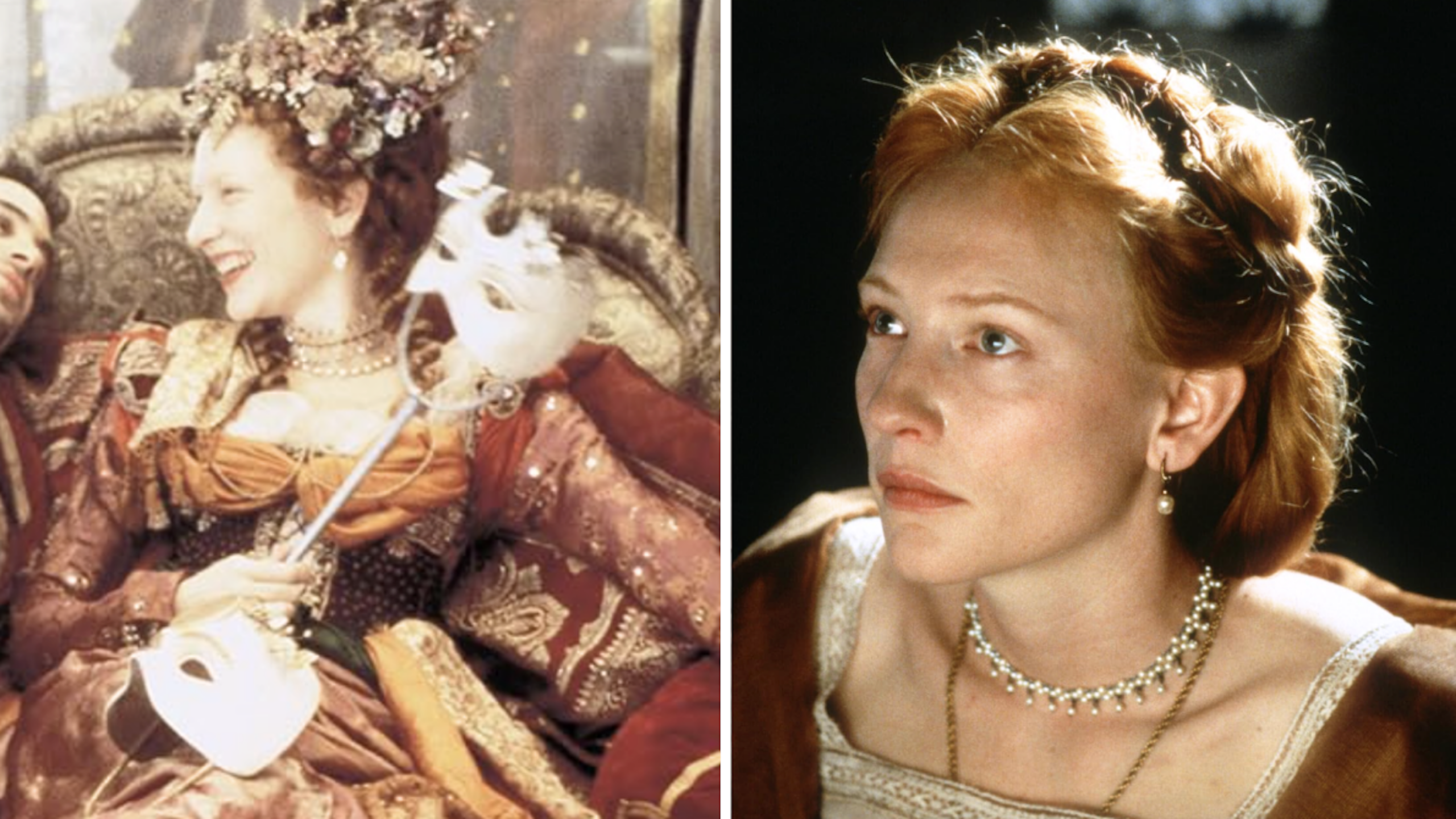
Before she was one of Hollywood’s most respected actresses, Cate Blanchett was a young Australian stage actor with only a handful of film roles behind her. Then came Elizabeth (1998). Director Shekhar Kapur cast her as a queen most audiences knew only from portraits: pale, powerful, and untouchable. What he and Blanchett delivered instead was a woman we watch being built, piece by piece. Elizabeth begins with a carefree young princess dancing in a meadow and ends with a monarch who has turned herself into a living symbol, her face painted white and her hair cut short. Every gown, every hairstyle, and every hardened glance in between marks a step on that path. The role earned Blanchett a Golden Globe, a BAFTA, and her first Oscar nomination, and the film took home the Academy Award for Best Makeup. These 13 images trace how a girl became the Virgin Queen and how an actress became a star.
1. A Queen Who Still Laughs
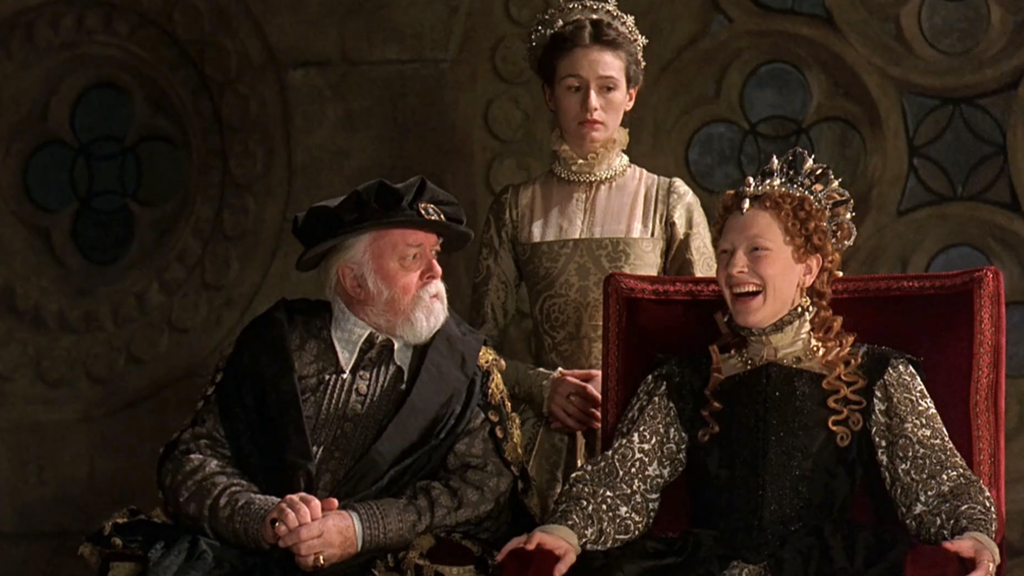
Early in her reign, Elizabeth hasn’t learned to hide anything yet. She laughs openly while her chief adviser, Sir William Cecil, played by Richard Attenborough, watches with visible concern. Blanchett plays these scenes with a lightness that’s easy to miss on a first watch, but it matters. The film needs us to see the young woman who exists before the crown takes over, so we can feel what she gives up.
2. Soft Curls and Quiet Calculation
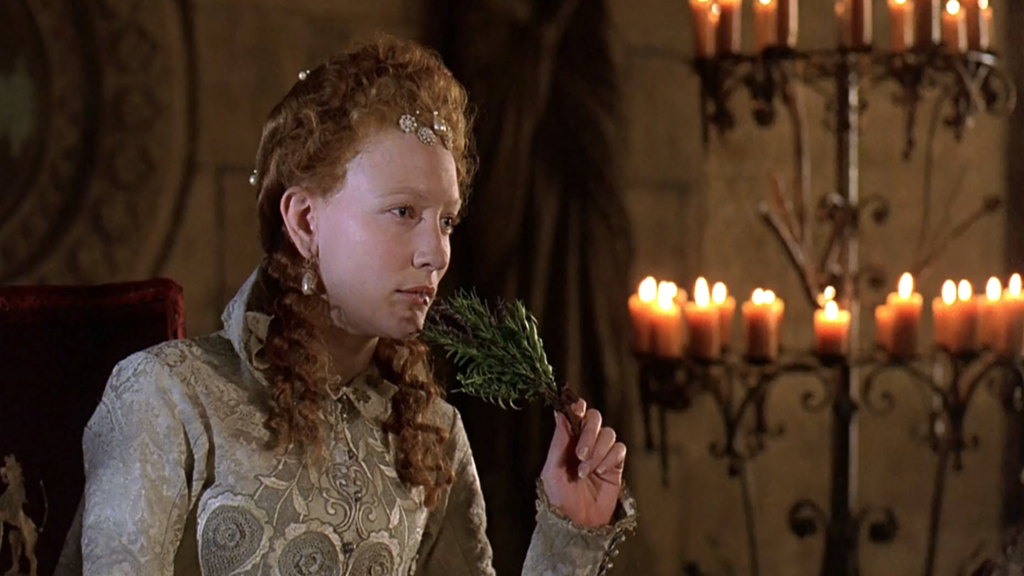
Her hair is still loose and romantic, decorated with delicate jeweled pins, but something has shifted in her eyes. Blanchett lets Elizabeth listen more than she speaks, weighing every voice in the room. It’s one of the subtle pleasures of the performance: long before the dramatic makeover, you can watch her start to think like a ruler, one careful pause at a time.
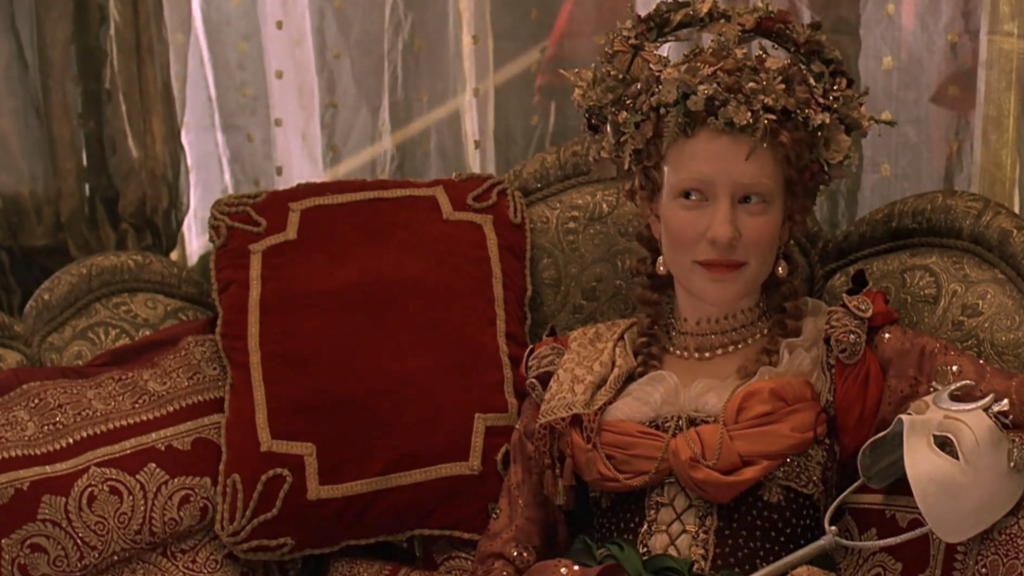
3. The Party Before the Price
The court of Elizabeth knows how to celebrate, and this masquerade look captures the young queen at her most playful. A crown of gilded flowers, warm colors, and a mask in hand make her look more like a guest than a monarch. Costume designer Alexandra Byrne, who earned an Oscar nomination for the film, dressed these early scenes in warmth and abundance, a world that will slowly drain of color.
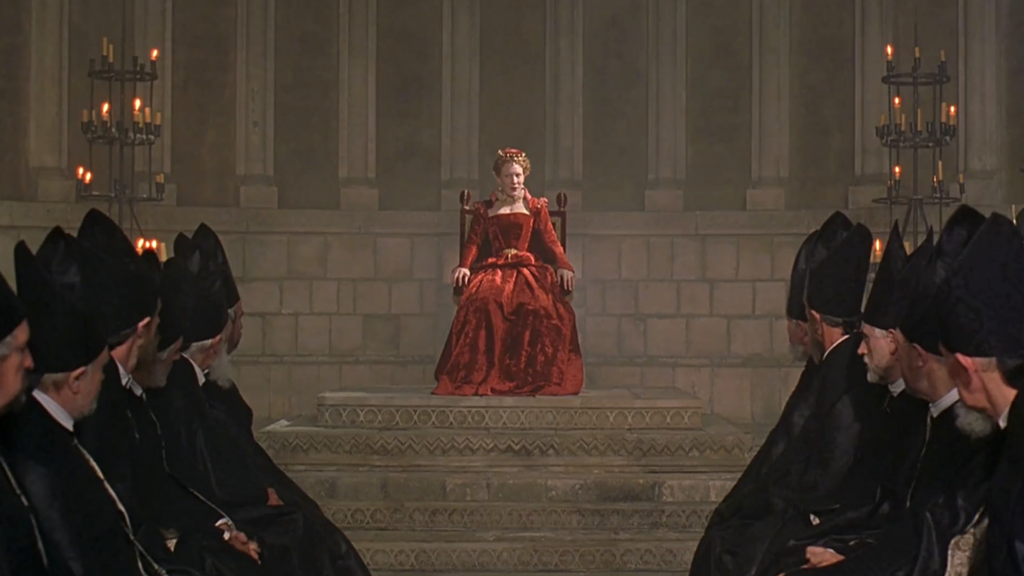
4. One Woman Against a Room Full of Men
This is the scene many fans remember. Dressed in deep red velvet, Elizabeth faces a chamber packed with stern bishops and lords who expect her to fail. Kapur frames her alone, small, and surrounded. Blanchett’s speech here is a turning point in the performance, as nerves give way to wit and authority. She wins the room, and the audience realizes this queen might be far stronger than anyone guessed.
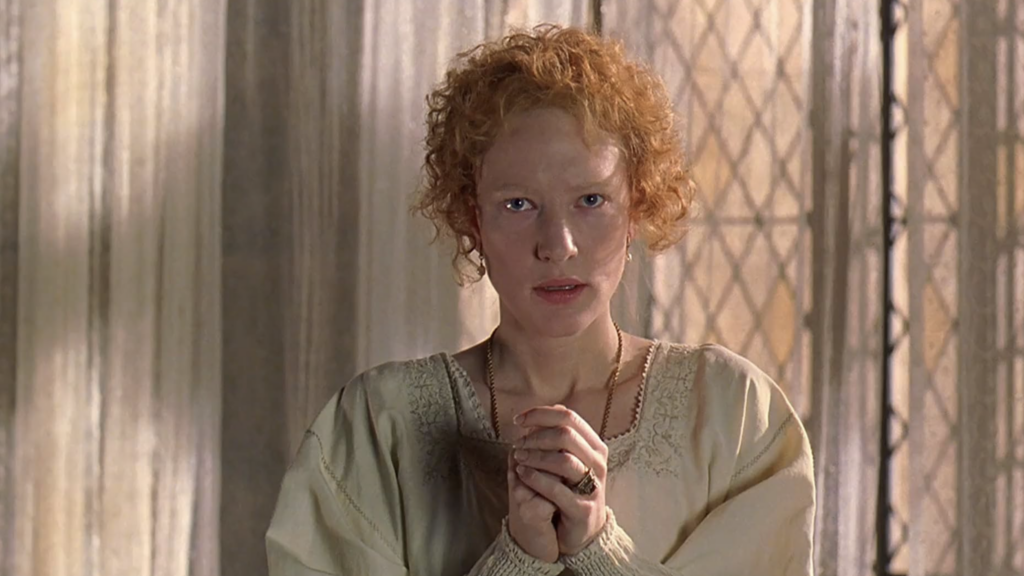
5. Stripped of Ceremony
Without the gowns and jewels, Elizabeth looks startlingly young. Her short curls are loose, her clothes are simple, and her hands are clasped as if bracing herself. Blanchett, then in her late twenties, uses moments like this to remind us how much pressure sits on one person. The contrast with the grand court scenes is deliberate: beneath every royal look, there’s still a woman deciding who she will become.
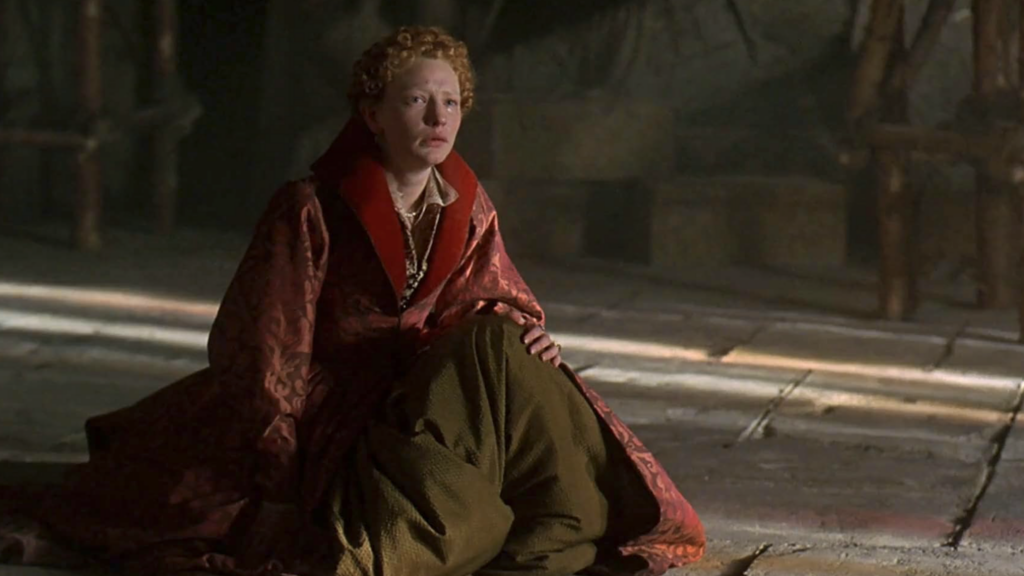
6. The Weight of the Crown
Not every step toward power looks triumphant. Here Elizabeth sits on the floor, overwhelmed, her robe pooled around her. Elizabeth is a thriller as much as a period drama, full of plots, betrayals, and danger closing in from every side. Blanchett never plays the queen as invincible, and moments of collapse like this one make her eventual transformation feel earned rather than inevitable.
7. Hair Down, Head High
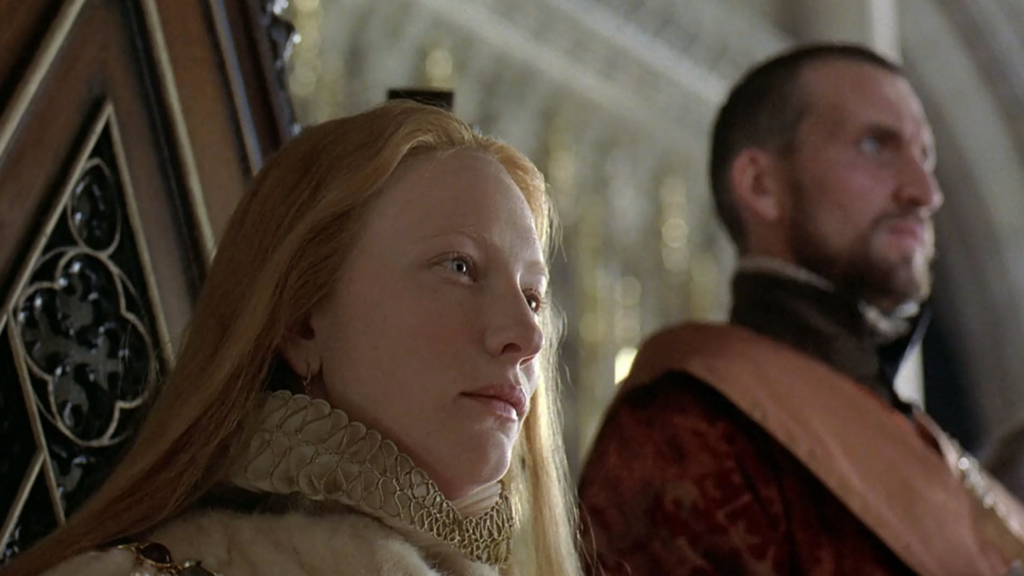
For her coronation, Elizabeth wears her long hair loose over her shoulders, a tradition that signaled youth and purity for an unmarried queen. Paired with a lace ruff and ermine, the look is regal but still gentle. Standing nearby is Christopher Eccleston as the Duke of Norfolk, one of the powerful men who sees her as an obstacle. The softness of her image here makes what comes later even more striking.
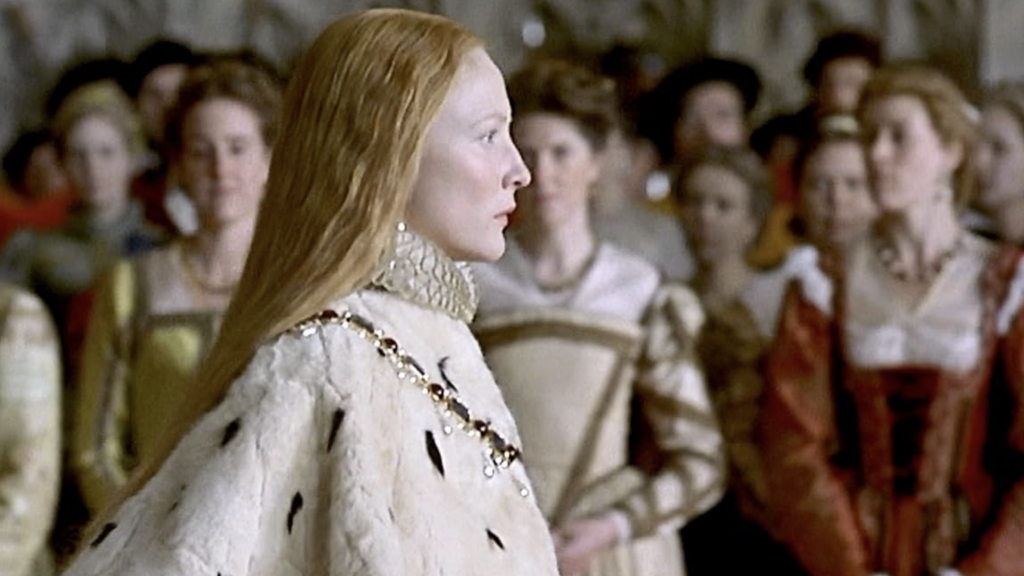
8. All Eyes on Her
Draped in ermine and walking through a crowd of courtiers, Elizabeth becomes the center of every gaze. Her profile is calm, almost unreadable. Blanchett’s stillness in these early ceremonial scenes is part of the story: she’s learning that a queen is always being watched, judged, and measured. Every step through the court is a performance, and she’s just beginning to master it.
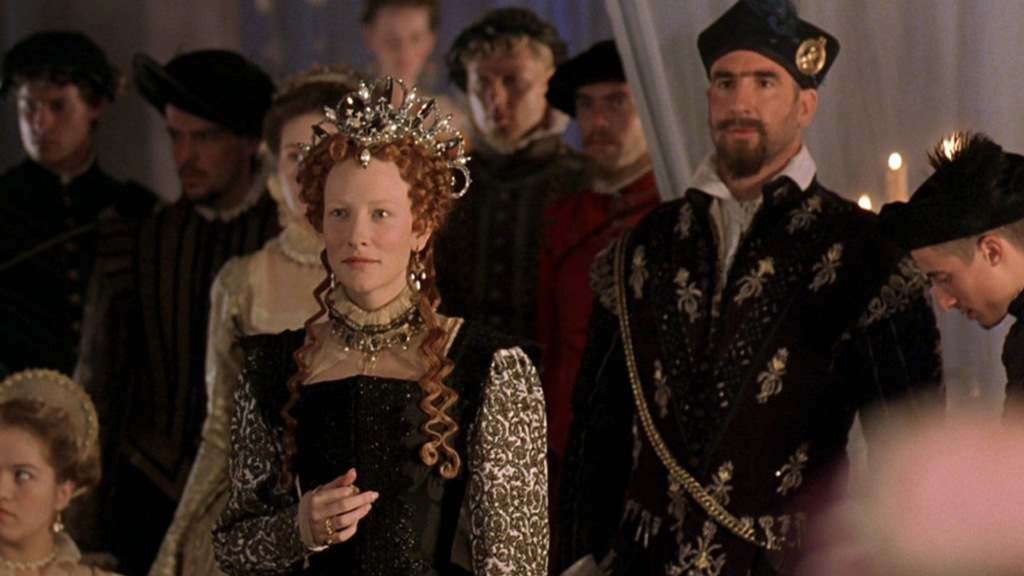
9. Ringlets, Diamonds, and Diplomacy
As foreign suitors and ambassadors arrive, Elizabeth’s look grows more elaborate. Sculpted ringlets fall beneath a glittering tiara, and her gowns become richer and more structured. Beside her stands a surprising face: French soccer legend Eric Cantona, who plays the French ambassador, Monsieur de Foix. Marriage was a political weapon, and every outfit in these scenes is part of the negotiation.
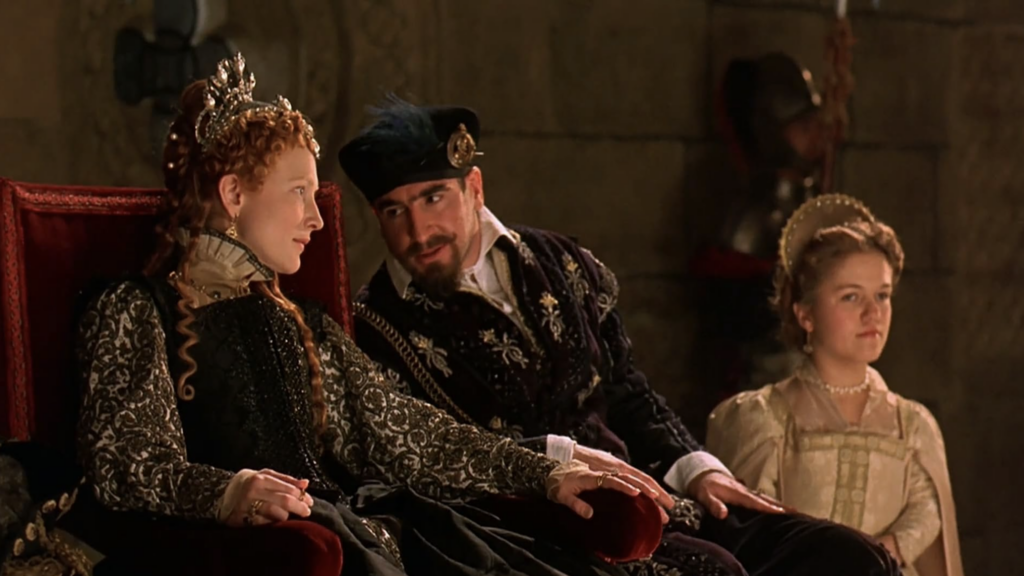
10. Playing the Game
Elizabeth has learned to flirt with power. She smiles politely at the ambassador’s whispered words while keeping her real thoughts to herself. Blanchett makes these exchanges fascinating because you’re never quite sure whether the queen is charmed or simply calculating her next move. By this point, the woman who laughed freely in the first image has learned that a smile can be a strategy.
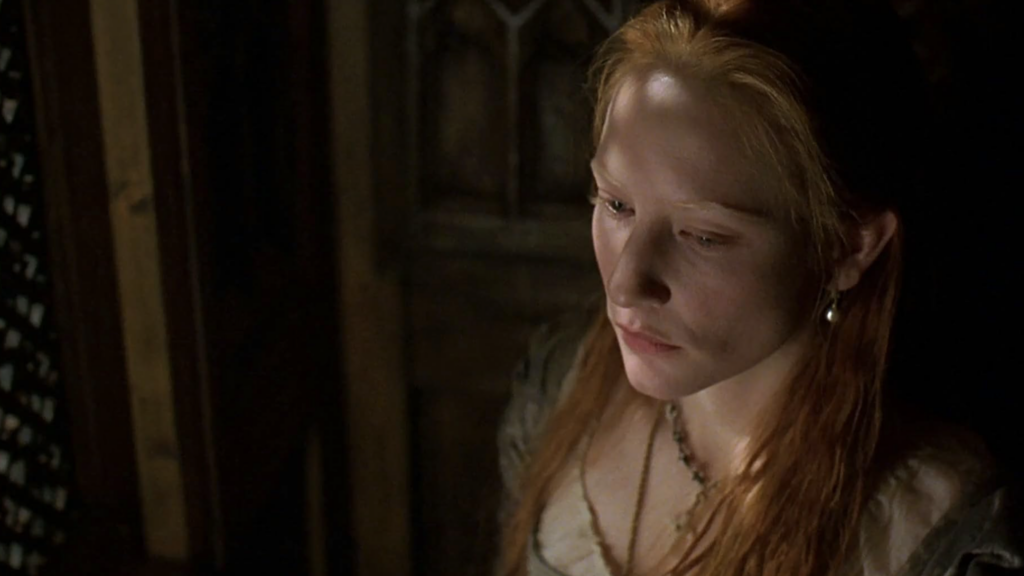
11. The Last Private Moment
Alone in the dark, with her hair falling loose and no crown in sight, Elizabeth looks inward one final time. This is the quiet before the transformation, the moment when the woman must decide what she is willing to give up to rule. Blanchett plays it almost without words, letting the silence carry the weight. What she chooses here will change her face, her life, and her legacy.
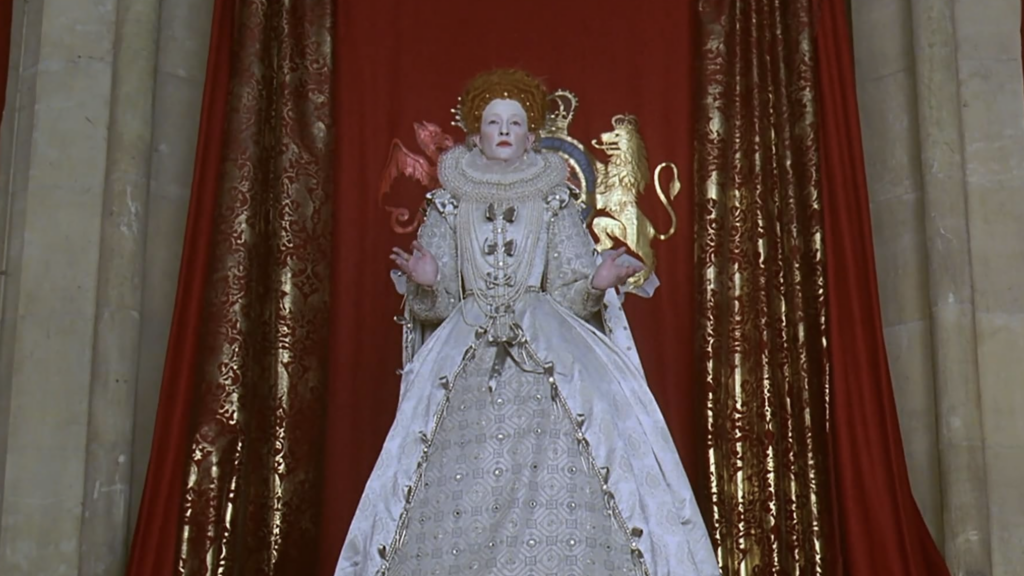
12. Married to England
The transformation is complete. Elizabeth stands before the royal coat of arms in a pearl-covered white gown, her face painted pale and her lips a sharp red. The makeup echoes the white face paint worn by the real queen, and it helped the film win the Oscar for Best Makeup. Blanchett barely moves, yet she seems enormous. The girl is gone, replaced by a symbol.
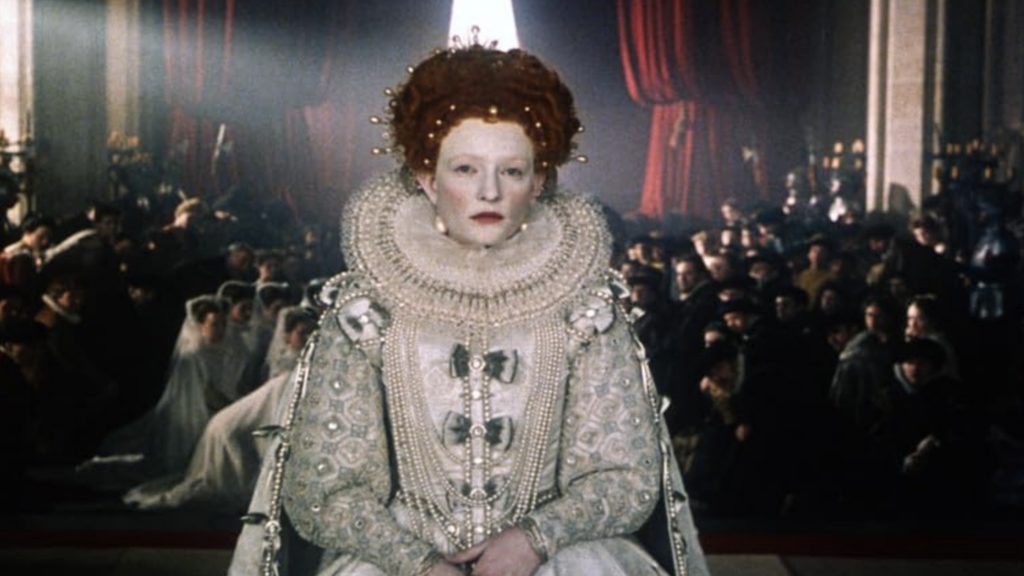
13. The Virgin Queen
The final image of Elizabeth is one of the most memorable endings of 1990s cinema. Seated before a kneeling court, framed by an enormous lace ruff, the queen looks less like a person than a portrait come to life. Blanchett would return to the role in Elizabeth: The Golden Age (2007), earning another Oscar nomination, but it was this moment that announced a new star.
Watch the full scene here → Queen Elizabeth I's coronation | Elizabeth