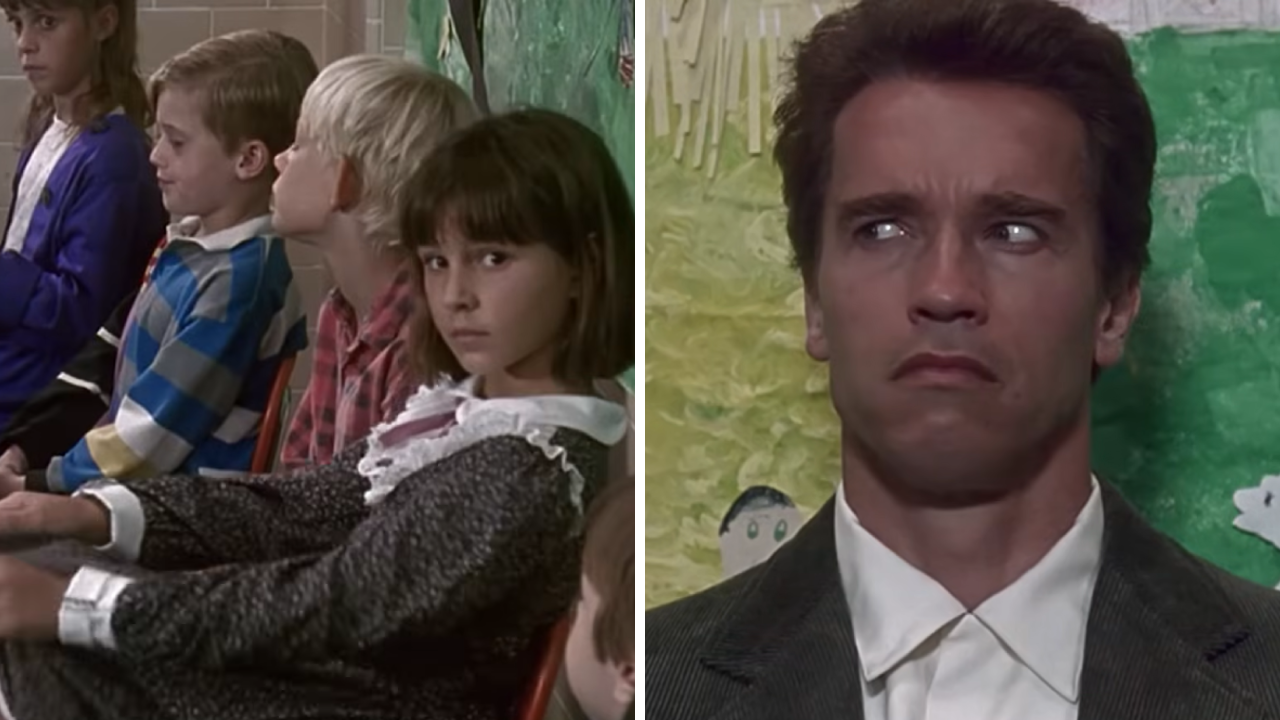
Kindergarten Cop (1990) gets most of its comedy from dropping Arnold Schwarzenegger into a room where none of his usual tough-guy skills are useful. Kimble walks into class expecting a few questions and some basic discipline. Within minutes, the kids are wandering around, asking to leave, ignoring him, and generally proving that kindergarten is its own kind of emergency.
Watching the scene now, though, there is another layer to it. The classroom is full of little details that were completely ordinary when the movie came out in 1990: chalkboards, carpet time, class pets, physical toys, and a school day with almost no visible technology. None of these things belonged exclusively to 1990, but together they make Kimble’s disastrous first day feel like a snapshot from a very different classroom era.
1. Carpet time is the center of the classroom
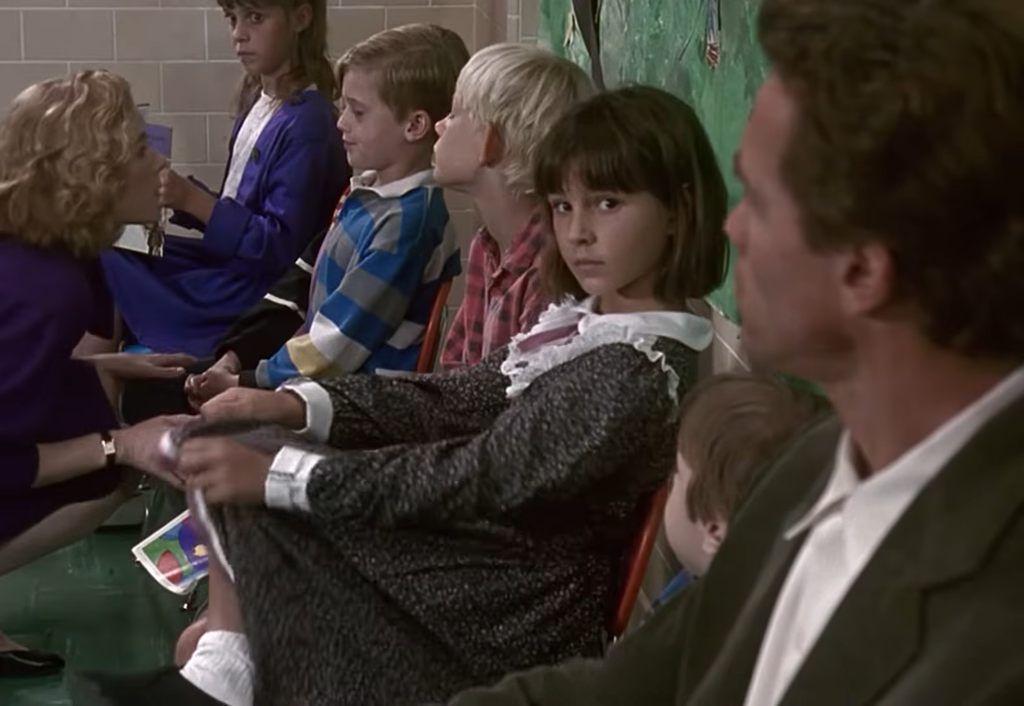
Kimble’s introduction doesn’t happen with the children sitting behind individual desks. They are gathered together on the floor while the teacher explains who this enormous stranger is and why he will be taking over their class.
That kind of carpet area is still common in early education, but the scene instantly gives the room a familiar late-20th-century elementary-school look. The carpet is where announcements happen, stories get told, and everyone can be pulled together before the next activity begins.
2. The chalkboard still runs the lesson
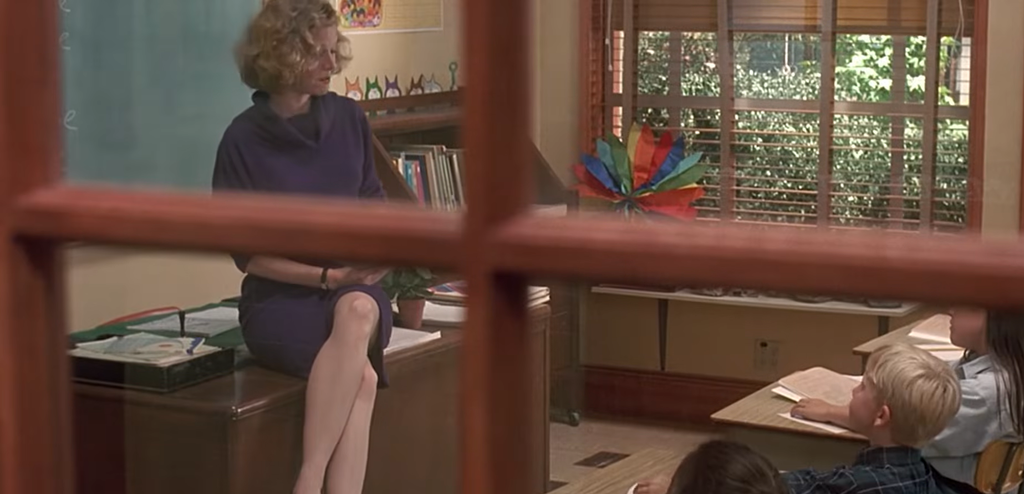
When Kimble escapes the room for a moment, we see another teacher standing in front of a chalkboard working through a phonics lesson. There is no presentation projected behind her and no interactive display. The board, the teacher, and the students are the whole setup.
It is such an ordinary image that the movie barely notices it. Three decades later, that simplicity is one of the things that dates the classroom most clearly.
3. Phonics is taught out loud, one word at a time
The neighboring class is working through the silent E rule, with the teacher having students write and pronounce examples together. It feels very hands-on and very direct: hear the rule, say the words, and write them down.
The scene lasts only a few seconds, but it captures a style of classroom instruction built around the teacher speaking to the whole room rather than students moving through individual digital exercises.
4. The room is packed with physical things to play with
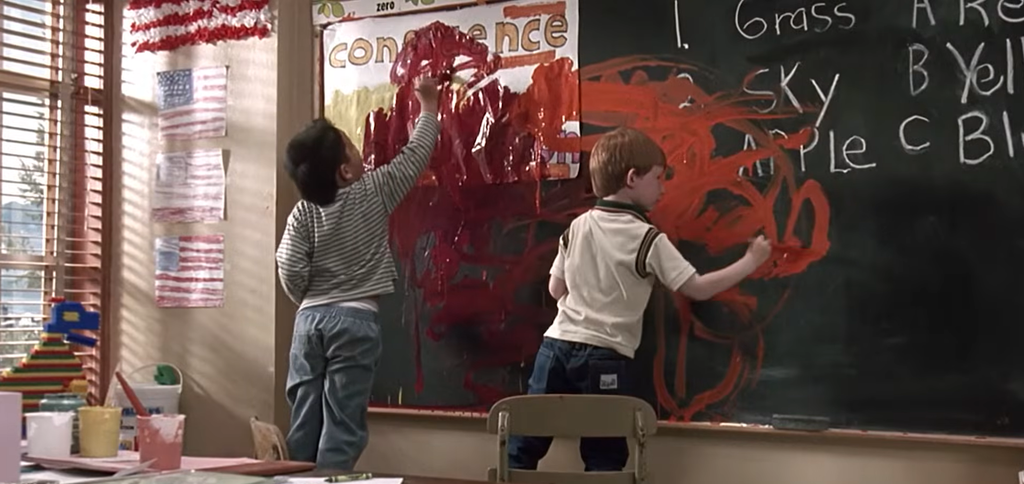
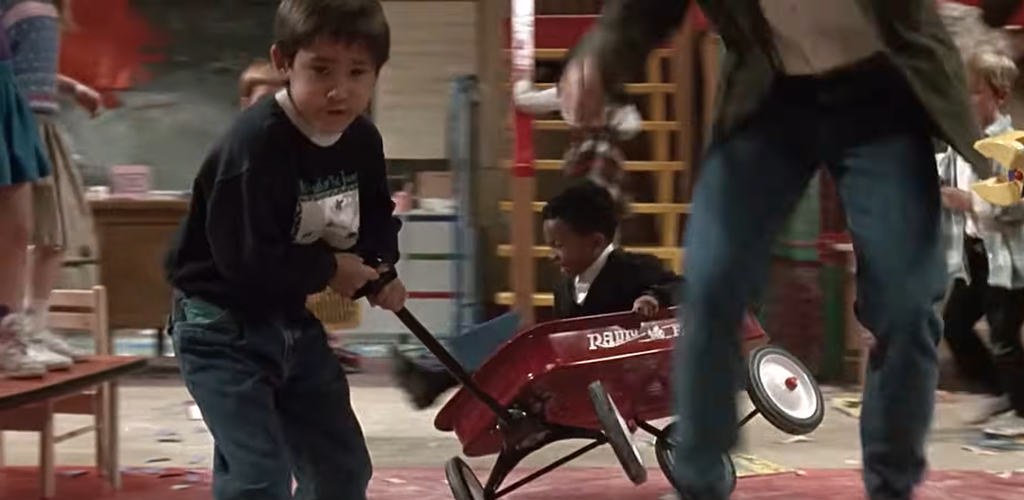
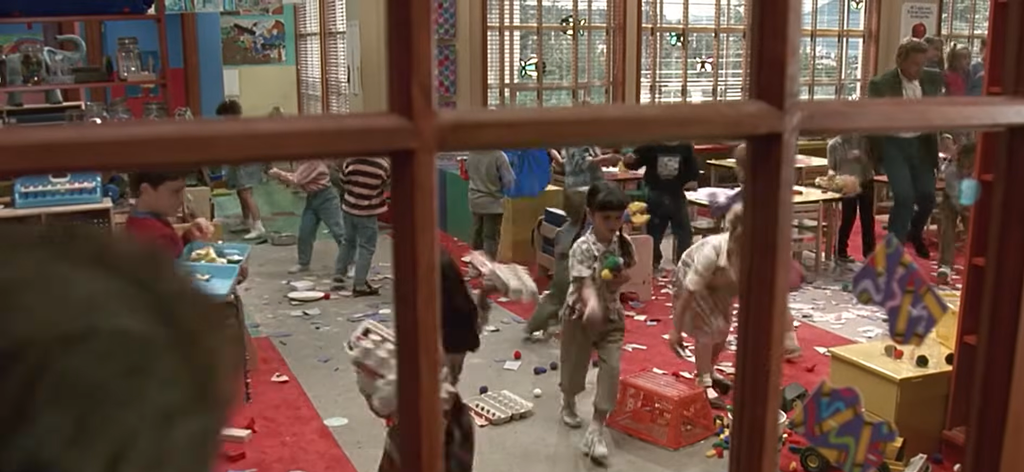
Once Kimble loses control, the classroom suddenly becomes much easier to study. Toys, blocks, shelves, craft materials, and play areas seem to be everywhere.
There is no single piece of equipment dominating the room. Instead, the space is designed around things children can pick up, move, build with, and scatter across the floor. Unfortunately for Kimble, they are very good at that last part.
5. There is almost no classroom technology in sight
Kimble has no laptop to open, no tablet to hand a student, and no screen he can turn to when he runs out of ideas. Even the classroom equipment disappears into the background compared with books, toys, paper, and the chalkboard.
That absence doesn’t mean schools in 1990 had no computers, but it does make the scene feel very different from a modern classroom where screens are much harder to avoid. Kimble has to hold the children’s attention himself. He discovers fairly quickly that he cannot.
6. Getting help means physically finding another teacher
When one student needs help that Kimble has absolutely no idea how to provide, he doesn’t send a message or call someone from the classroom. He walks out and looks for another teacher.
The solution is almost comically direct: find an adult who knows what they are doing and ask them to step in. It also helps the movie show just how unprepared Kimble is. Everyone else seems to understand how the school works except the undercover detective pretending to belong there.
7. The principal is a constant physical presence
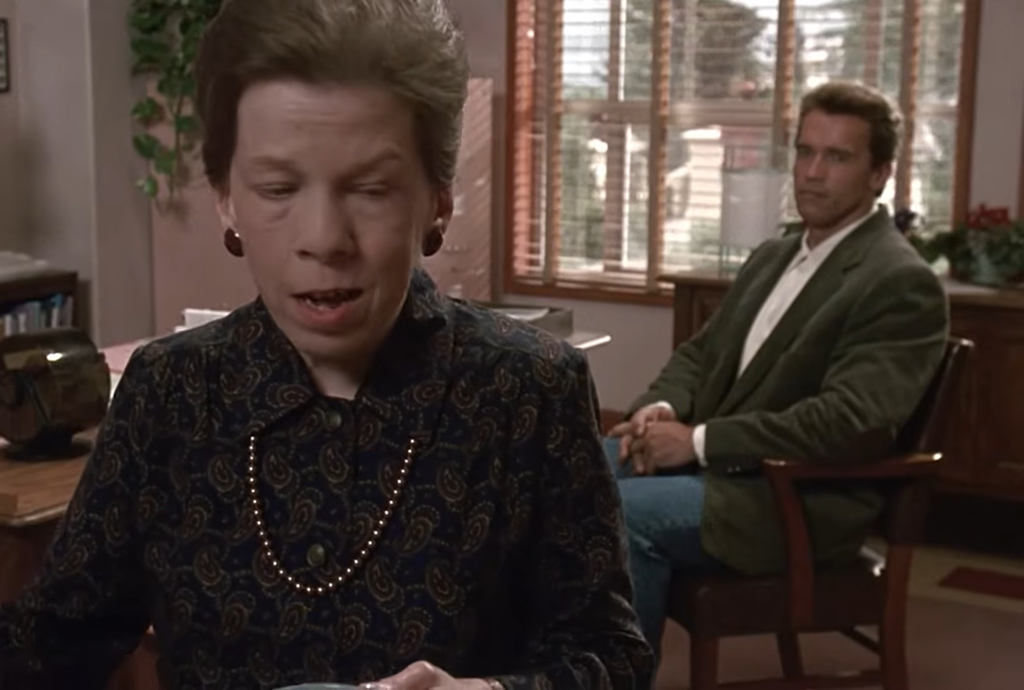
Principal Schlowski doesn’t just approve Kimble’s placement from an office somewhere. She meets him, questions whether he has any teaching experience, walks him into the classroom, and makes it very clear that she intends to keep an eye on him.
That face-to-face supervision gives the school a small, contained feeling. Kimble can’t disappear behind paperwork or communicate through an administrative system. If he loses control of the class, the principal may literally be standing in the hallway watching it happen.
8. A class pet can become the entire activity
Kimble’s first real breakthrough comes when he brings in his ferret. Suddenly the kids are interested. They gather around, ask questions, and wait for their chance to pet it.
It is one of the most charmingly low-tech solutions imaginable. Kimble doesn’t need a lesson plan once the animal appears. The ferret becomes the lesson, the entertainment and, for a few precious minutes, the thing keeping everybody in roughly the same place.
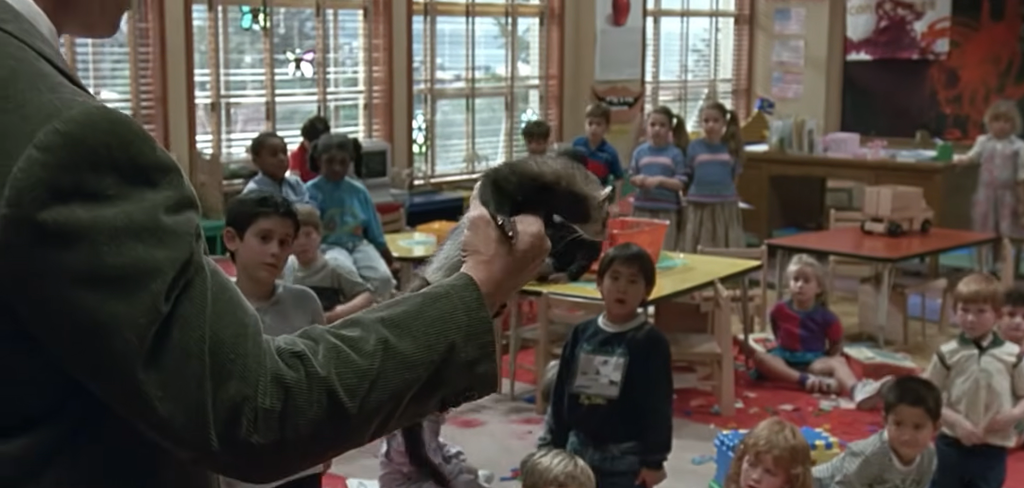
9. Kids are expected to line up and wait their turn
Once the ferret arrives, Kimble finally manages to create some order by having the children approach one at a time. The simple act of forming a queue immediately makes the room look more like the classroom he was hoping to run.
That rhythm of lining up, waiting, taking a turn, and moving on is one of those tiny school routines that barely registers when you are a kid. Here it becomes a victory because Kimble has spent most of the morning failing to get anyone to do anything in the same order.
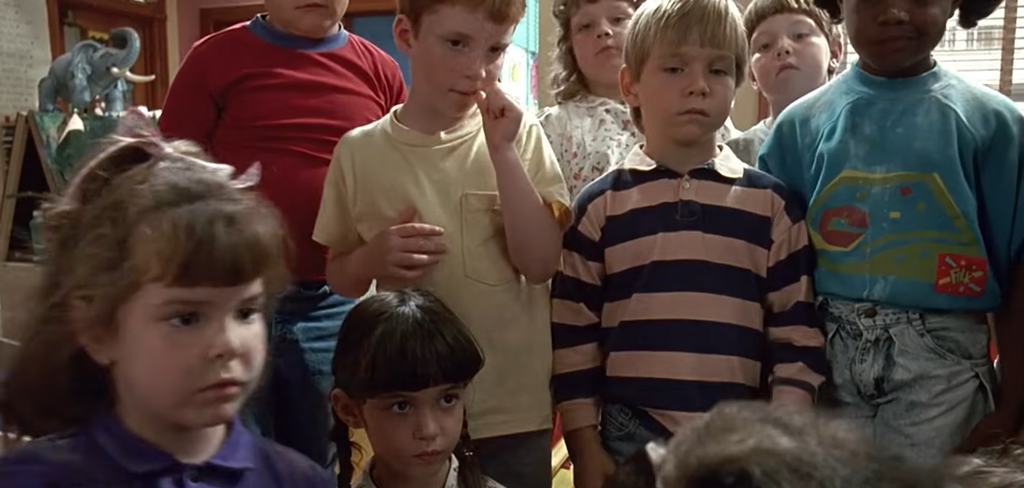
10. One child’s schedule is basically a list of adults
Near the end of the day, a student explains exactly why Kimble doesn’t measure up. Her mother teaches at the school, another adult watches her during tutoring, she has a swimming teacher, and she has a T-ball coach. According to her, every one of them is better at this than Kimble.
The joke works because a child’s world is being organized through this whole network of teachers, coaches, relatives, and caregivers. There is no shared calendar or stream of messages connecting all of it in the scene. She simply knows who takes care of her, where she goes, and which adults are supposed to know what they’re doing. Kimble, unfortunately, has just spent the entire day proving he is not on that list.
To Buy or Watch Kindergarten Cop, click here: https://www.amazon.com/Kindergarten-Cop-Arnold-Schwarzenegger/dp/B001VLLES4