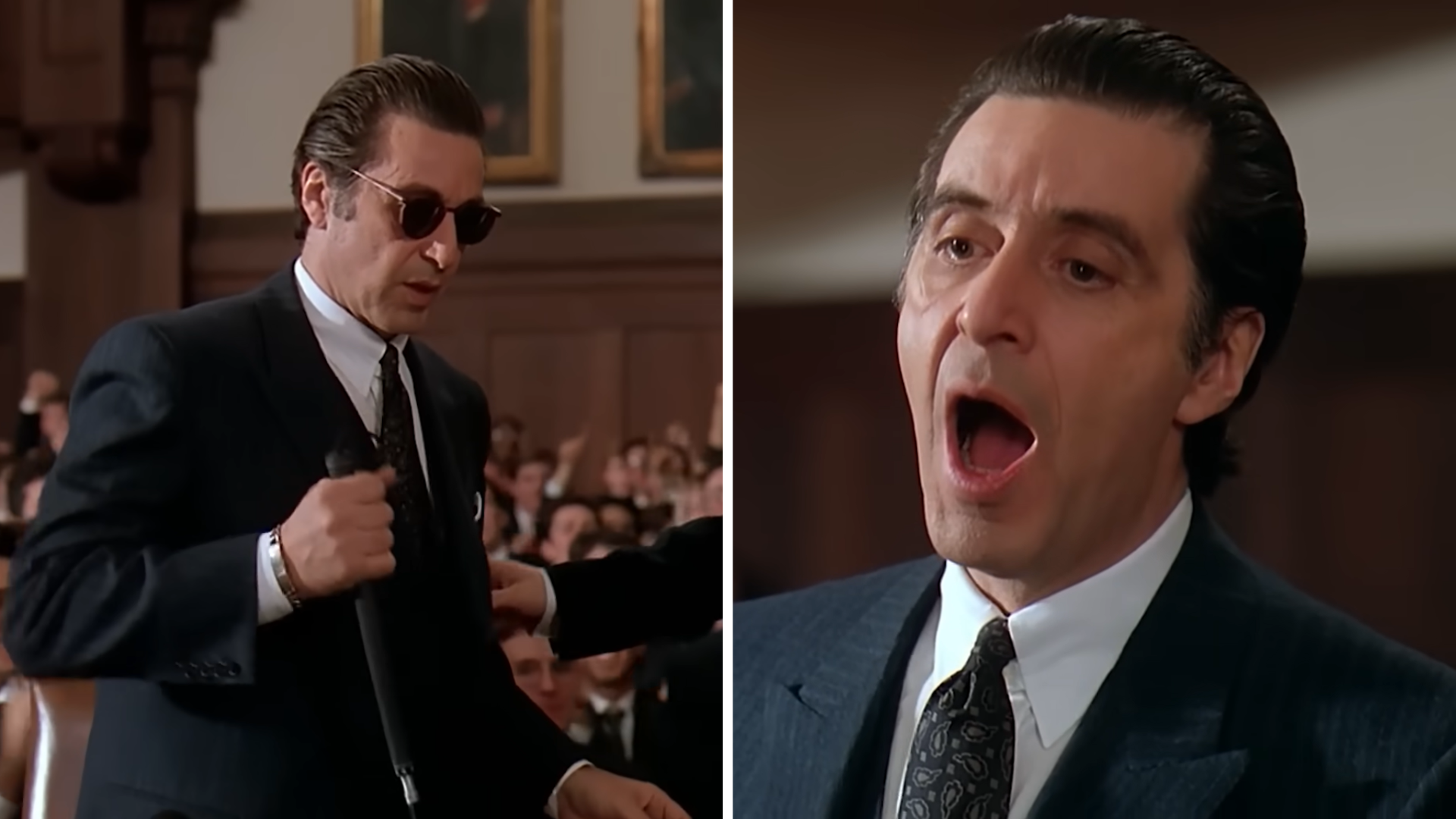
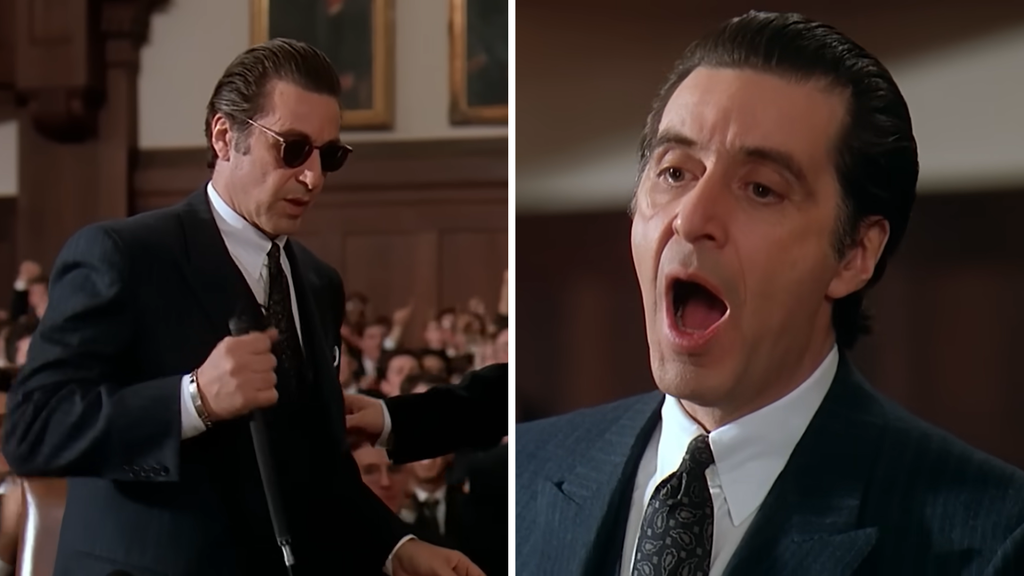
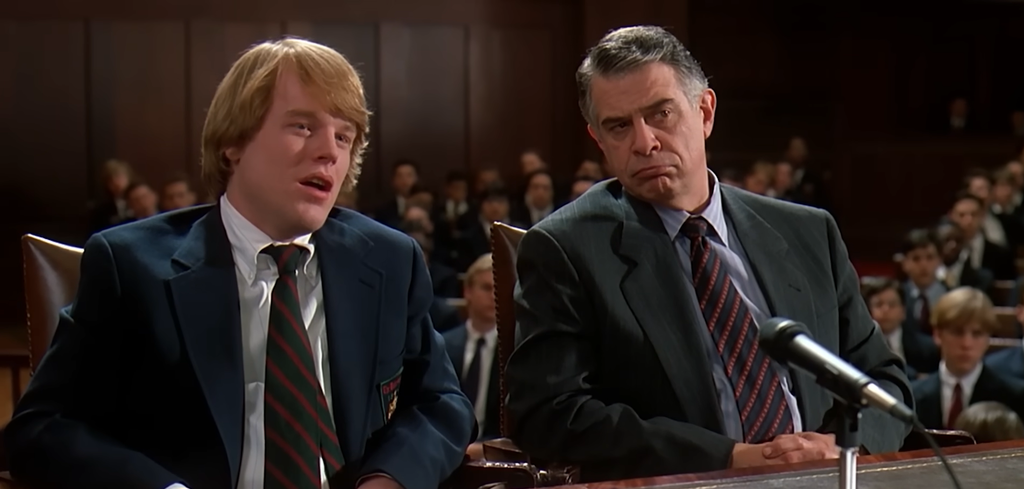
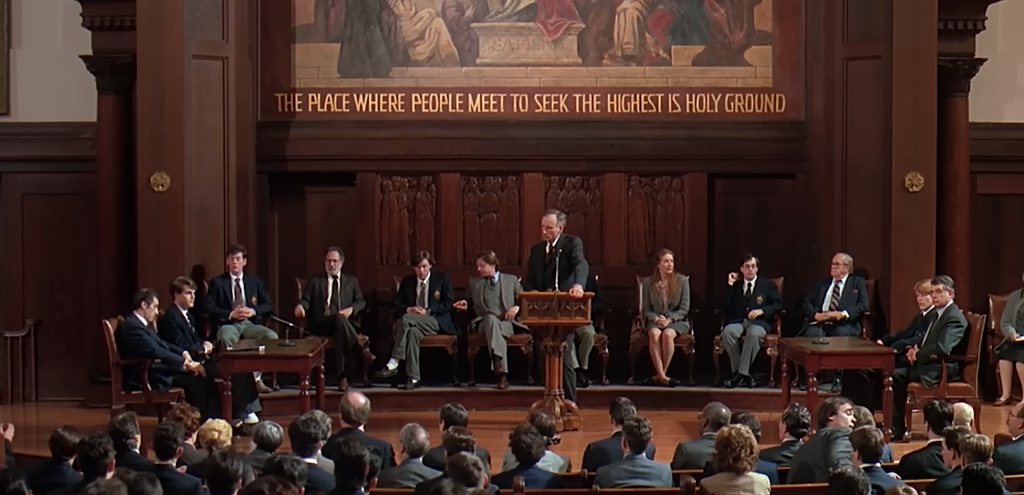
Frank Slade does not arrive at Charlie Simms’ disciplinary hearing, planning to give a grand speech. For most of the proceedings in Scent of a Woman (1992), he sits beside Charlie and listens as Headmaster Trask questions the students, accepts George Willis Jr.’s carefully limited testimony, and finally recommends Charlie’s expulsion for refusing to identify his classmates.
What follows is remembered as one of Al Pacino’s big showcase scenes, which got him the only Oscar in his entire career, but the performance has more shape than its loudest moments suggest. Frank starts with a brief interruption, gradually widens his argument from Charlie to the values of the school itself, draws on his own regrets, and eventually brings the speech back down to one teenager whose future is at stake.
1. Frank waits until Trask condemns Charlie
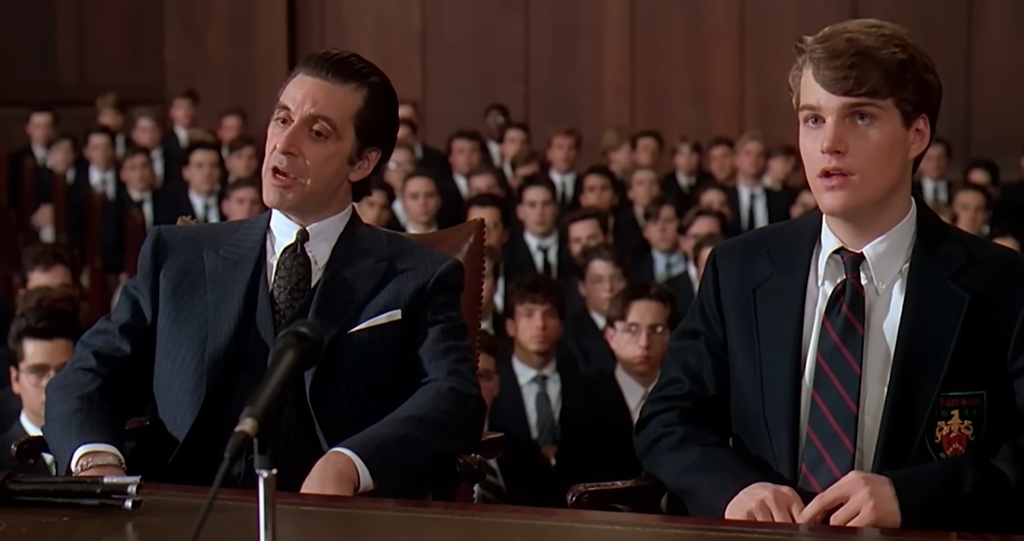
Pacino spends the first part of the hearing letting James Rebhorn’s Trask control the room, which gives Frank’s intervention a specific trigger. He speaks up only after Trask calls Charlie dishonest and recommends expulsion, answering the accusation by pointing out that Charlie has at least refused to inform on his classmates. The delay makes Frank feel less like someone looking for an audience and more like someone who has finally heard enough.
2. He begins with a much smaller argument than the one he ends with
Frank’s opening defense is remarkably compact compared with what follows. Instead of immediately attacking Baird, he first reframes the accusation against Charlie: the same silence Trask treats as evidence of dishonesty can also be read as loyalty. Pacino keeps the opening relatively contained, which gives the performance somewhere to go once Trask challenges him and Frank begins questioning what being a “Baird man” is supposed to mean.
3. He uses Baird’s own standards against the school
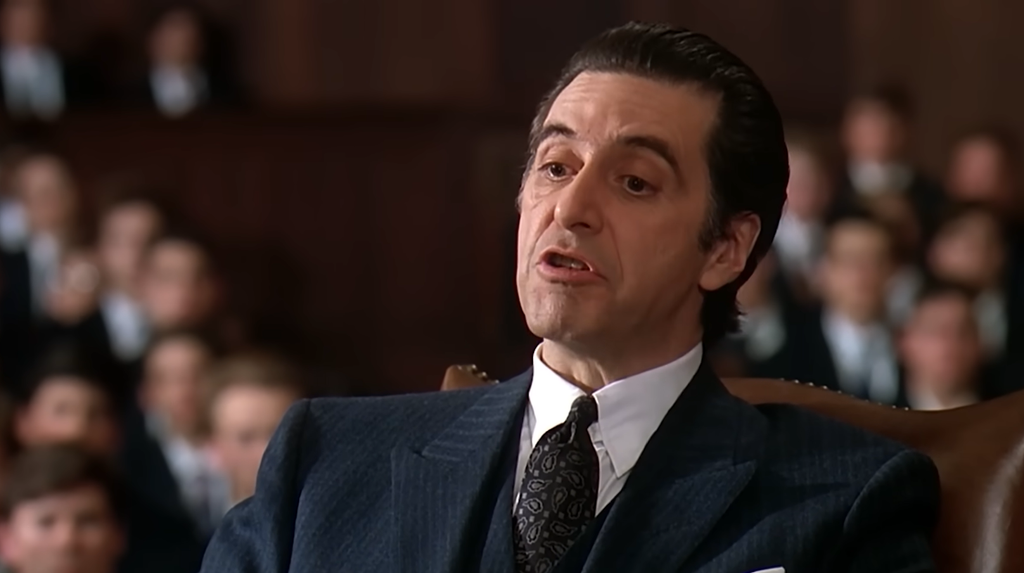
Trask has spent the hearing presenting Baird as an institution built around standards, reputation, and leadership, so Frank does not reject those ideals outright. He asks whether the school is actually living up to them. The argument becomes much sharper once he suggests that Charlie’s refusal to protect himself at someone else’s expense may show more character than the behavior Baird is prepared to reward.
4. Charlie and George give him a comparison the room can see
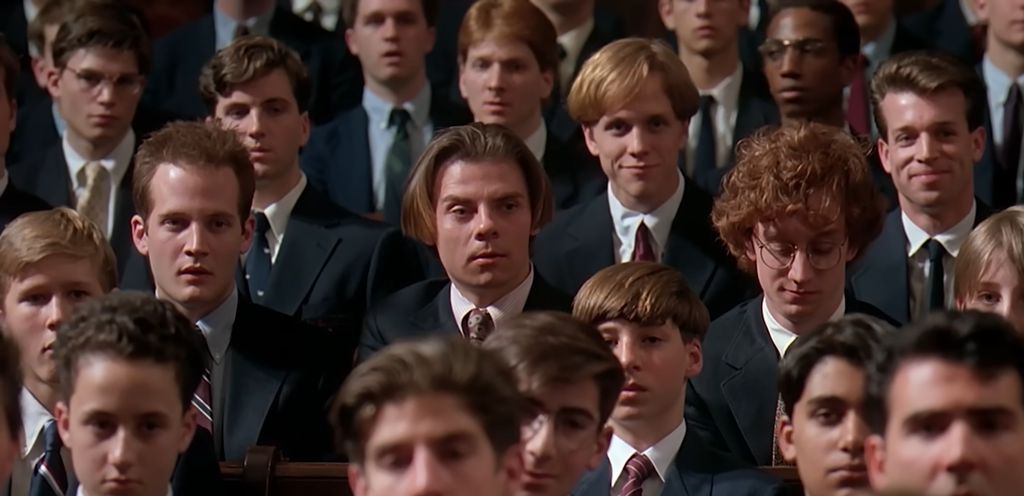
Frank does not leave the discussion at the level of school mottos. He directs the audience toward Charlie, who is facing expulsion rather than identify the students responsible, and George, whose father has helped him give testimony without fully committing himself. That contrast lets Pacino turn an abstract debate about integrity into something visible in the room, with two students making very different choices under pressure.
5. Trask’s challenge gives Pacino permission to change gears
When Trask asks whether Frank is finished, Pacino does not simply continue at the same intensity. Frank makes it clear that he has only begun, and from that point the target grows from one disciplinary decision to the culture of Baird itself. Pacino also introduces more sarcasm as he invokes the school’s illustrious past, giving the middle of the speech a different rhythm before the confrontation becomes more serious again.
6. The humor keeps the speech from staying on one emotional note
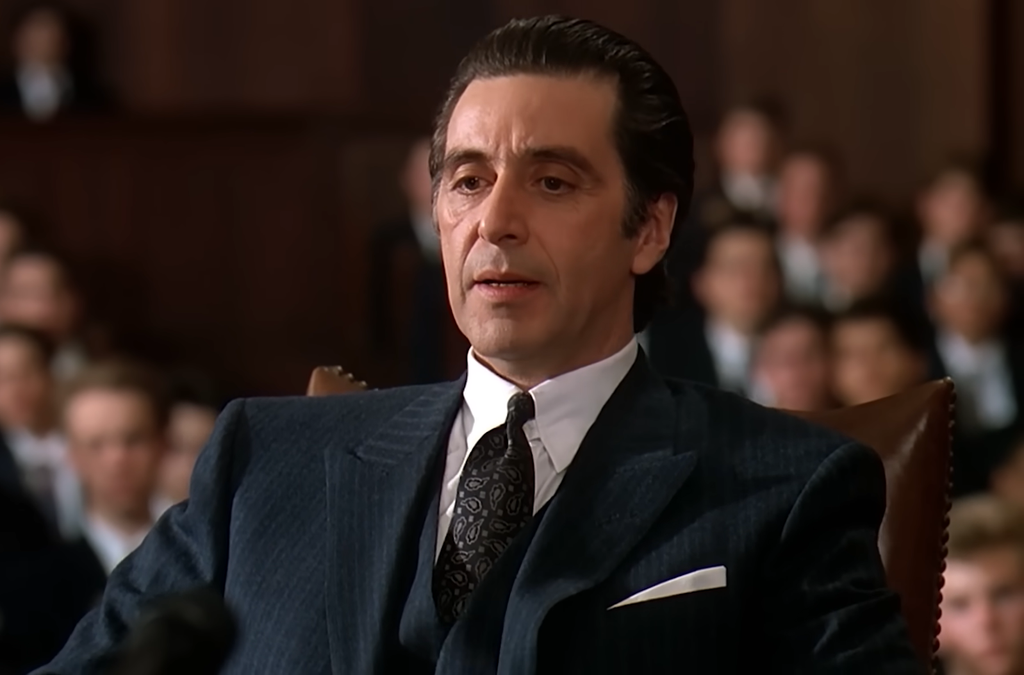
Frank’s references to famous former students are deliberately messy and irreverent, with historical names mixed together as he dismisses the prestige Trask has been relying on. Pacino gets laughs without allowing the scene to become comic relief; the humor makes Frank sound less rehearsed and more like a man thinking his way through an argument in real time. That looseness also makes the harder material that follows feel less like a prepared monologue.
7. Standing up changes the physical scale of the scene
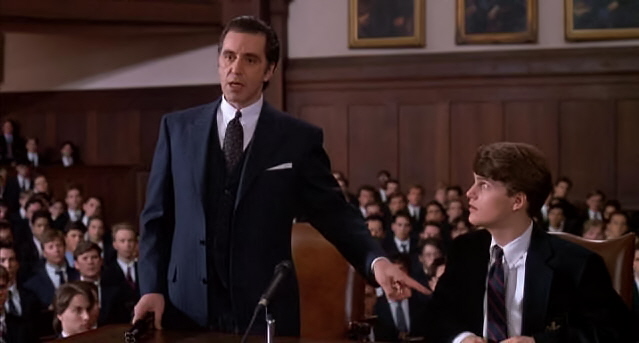
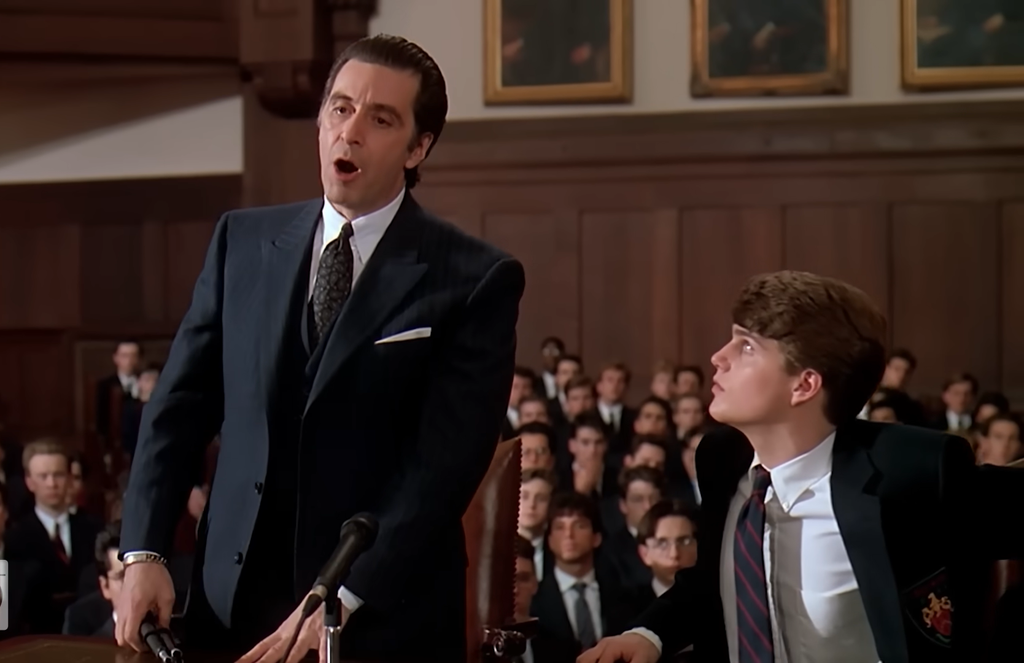
Pacino delivers much of the early argument from beside Charlie, but the confrontation takes on a different presence once Frank rises after Trask tries to bring him back under control. Because Frank cannot visually lock onto the people he is addressing, Pacino relies heavily on posture, the direction of his head, his cane, and the force of his voice to command the room. Pacino later explained that while playing Frank he avoided focusing his eyes on people or objects, a technique that shaped the character’s physical behavior throughout the film.
8. Frank’s own failures give the argument more weight
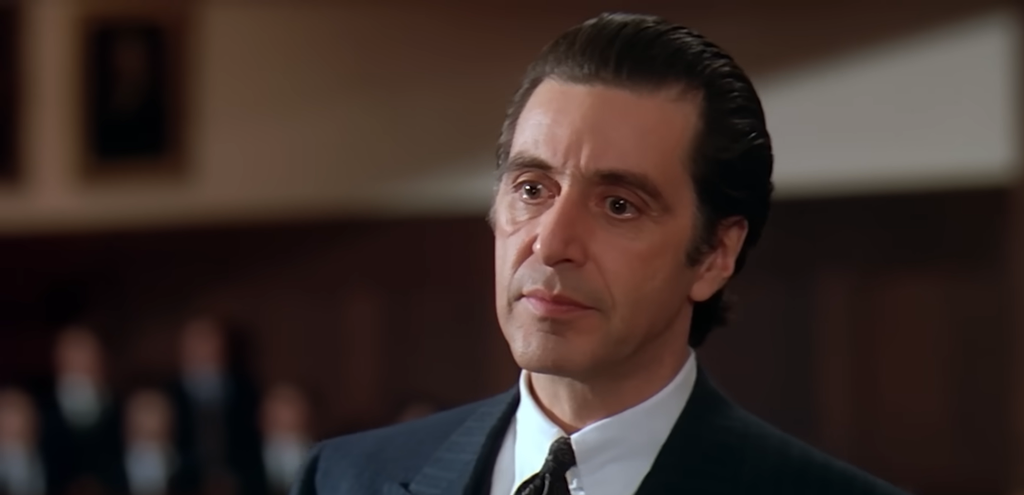
The speech becomes more personal when Frank stops talking only about what Baird is doing wrong and begins drawing on what he has seen and experienced himself. He knows what a damaged character looks like and later admits that he has faced moments when he could recognize the right path without having the courage to take it. That confession changes his authority in the scene: Frank is not presenting himself as a perfect example for Charlie but as someone who understands the cost of making the wrong choice.
9. He brings Trask’s idea of leadership back near the end
Frank eventually returns to one of the concepts Baird has been invoking throughout the hearing: leadership. By then, however, he has changed what the word means inside the scene. Leadership is no longer tied to school reputation or knowing how to protect yourself when trouble arrives; Frank argues that Charlie has already shown the more difficult kind by refusing to trade his principles for an easier outcome. The structure works because the standard used against Charlie earlier becomes part of Frank’s case for him.
10. Pacino finishes with Charlie instead of the institution
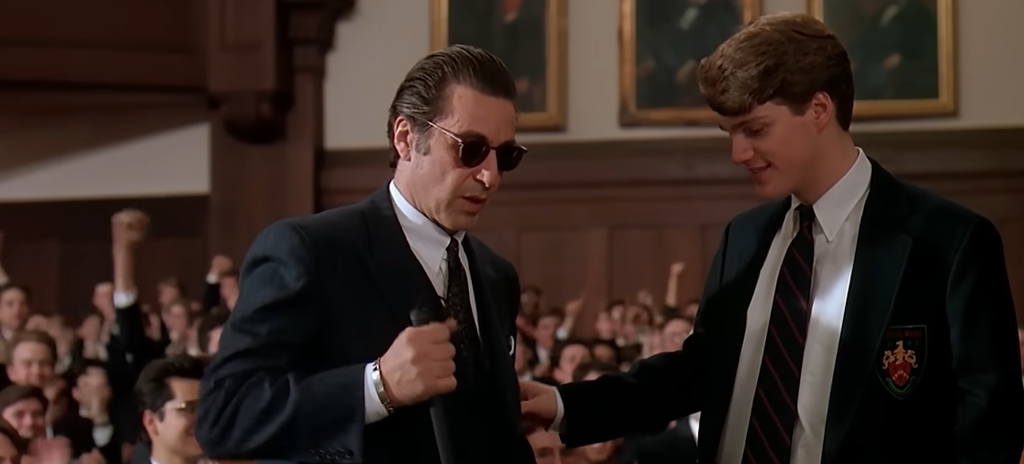
After spending much of the speech attacking Baird, Frank narrows the final appeal back to the teenager sitting beside him. He asks the committee to protect Charlie’s future and allow him to continue on the path he has chosen, while Pacino eases away from the more confrontational delivery of the middle section. The change gives the ending warmth that another burst of anger would not have provided, and it reminds the committee that the argument is ultimately about what happens to one student after the room empties.
To Watch or Buy Scent of a Woman, click here: https://www.amazon.com/Scent-Woman-Al-Pacino/dp/B000I9WW4U