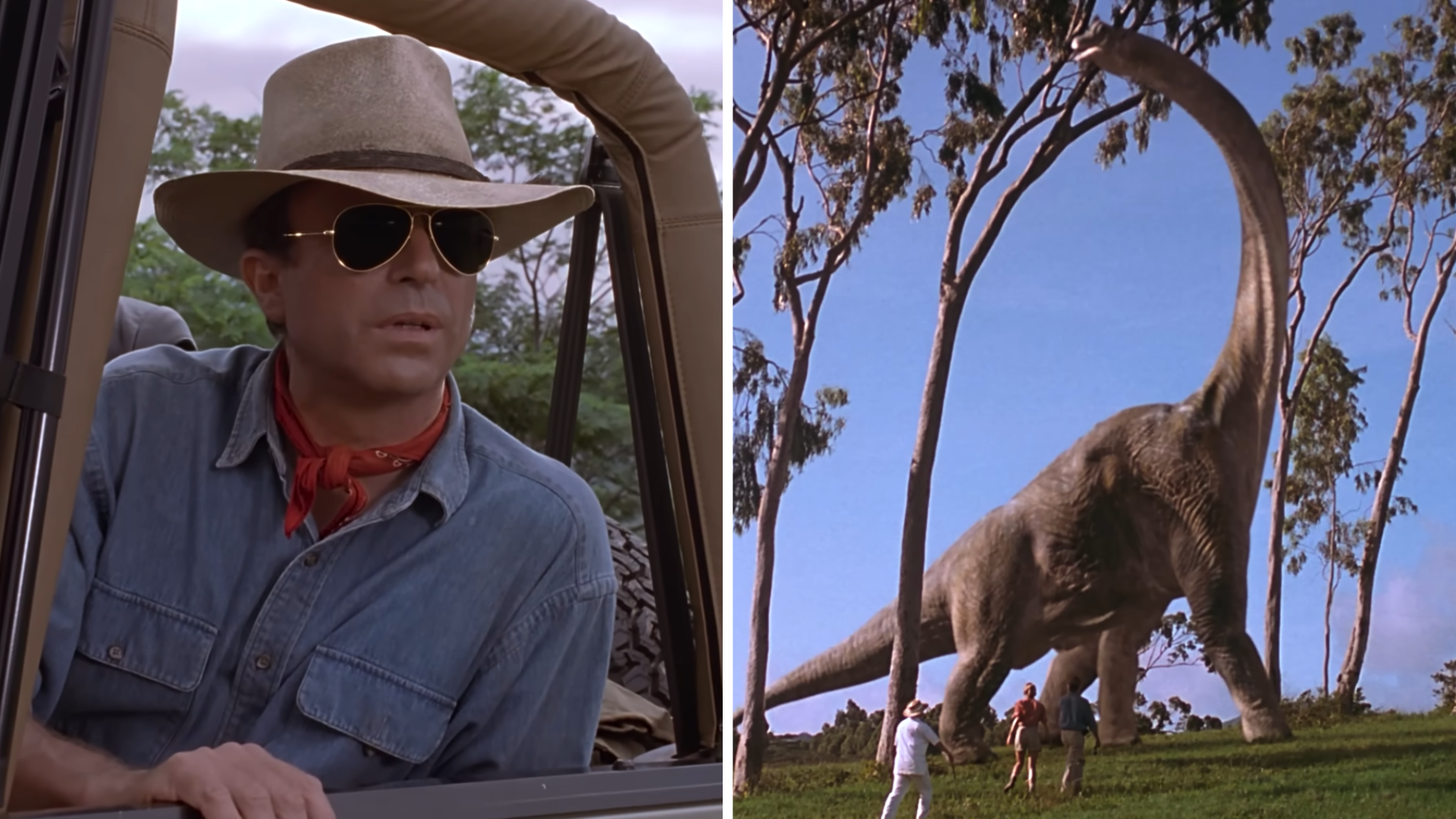
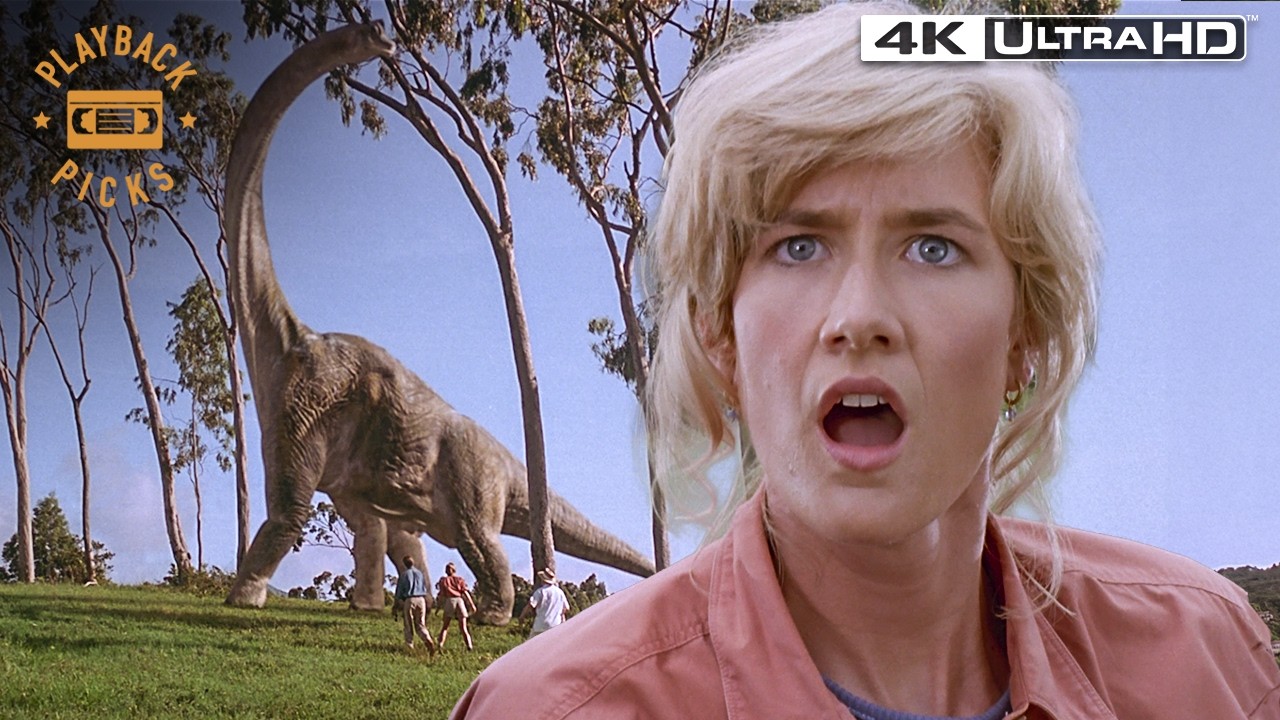
The first dinosaur reveal in Jurassic Park (1993) lasts only a few minutes, but Steven Spielberg makes the audience wait for it. Alan Grant notices something outside the Jeep, removes his glasses, and turns Ellie Sattler toward it before we are finally allowed to see the Brachiosaurus towering over the landscape.
Behind that reaction was a mixture of brand-new digital technology and surprisingly simple filmmaking tricks. Sam Neill and Laura Dern had little more than a marker to look at, a real tree was pulled by a cable to interact with an animal that was not there, and even the landscape required some unexpected reconstruction before the scene was finished.
1. Spielberg shows Grant before he shows the dinosaur
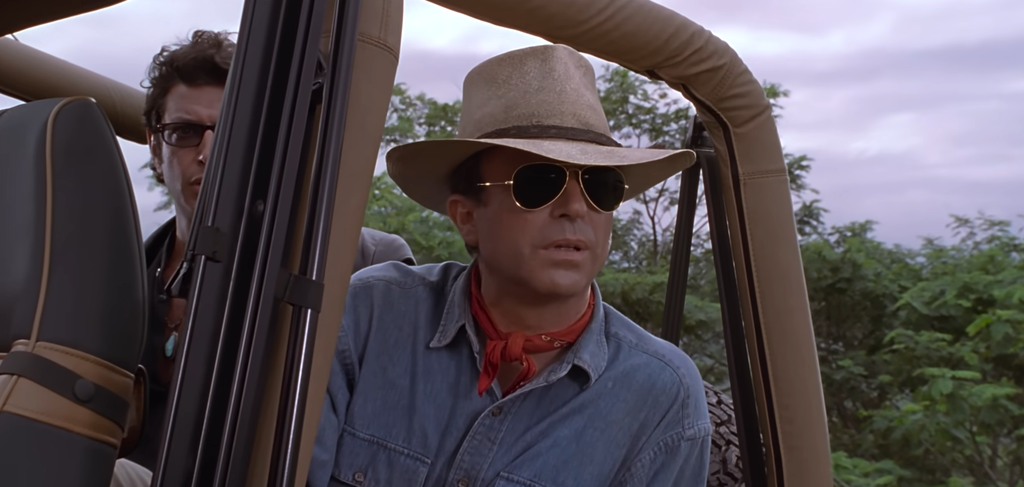
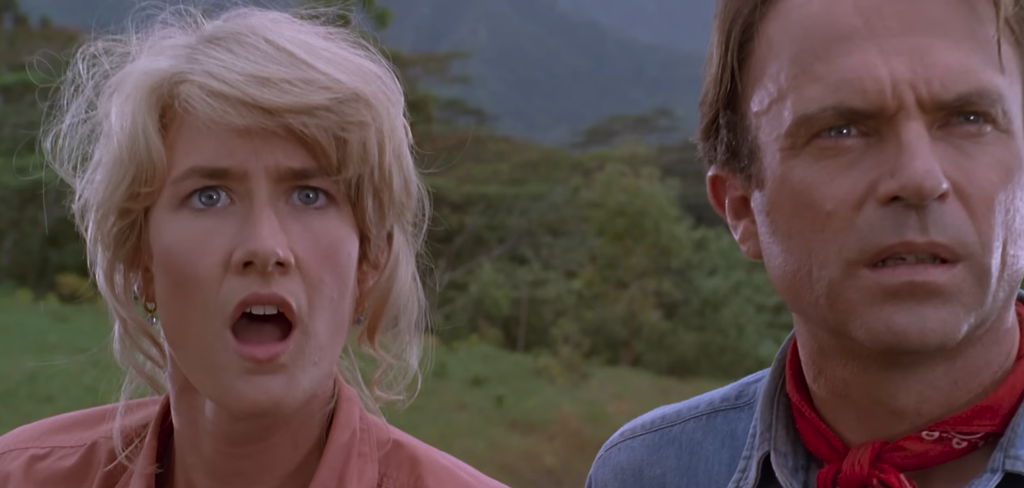
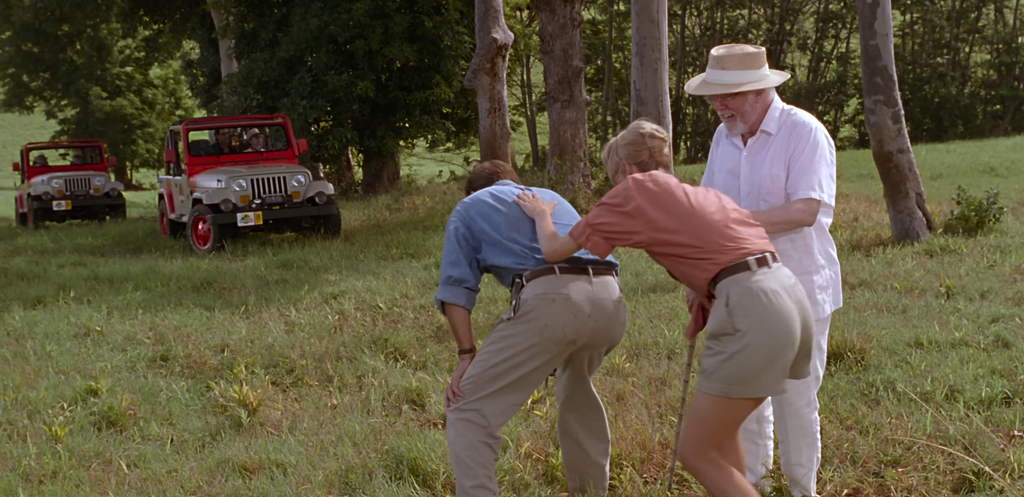
The Brachiosaurus does not get the first reaction shot: Grant does. Spielberg stays with Sam Neill as he notices something outside the Jeep, slowly removes his sunglasses, and stares upward, giving the audience time to understand that whatever he is seeing has completely interrupted his train of thought. Grant then reaches over and turns Ellie’s head toward the same sight before the movie finally cuts to the dinosaur, so much of the anticipation comes from watching two paleontologists process the impossible before we get to share their view.
2. Sam Neill and Laura Dern were looking at an X on paper
There was obviously no enormous animal standing off camera for Neill and Dern to react to. Dern recalled that the actors were given an X on a piece of paper placed up in a tree to establish where they should look. The crew then had to explain just how much larger the finished Brachiosaurus would be so the actors could adjust their eyelines and take in the imaginary creature from head to tail.
3. The Brachiosaurus was part of a major CGI breakthrough
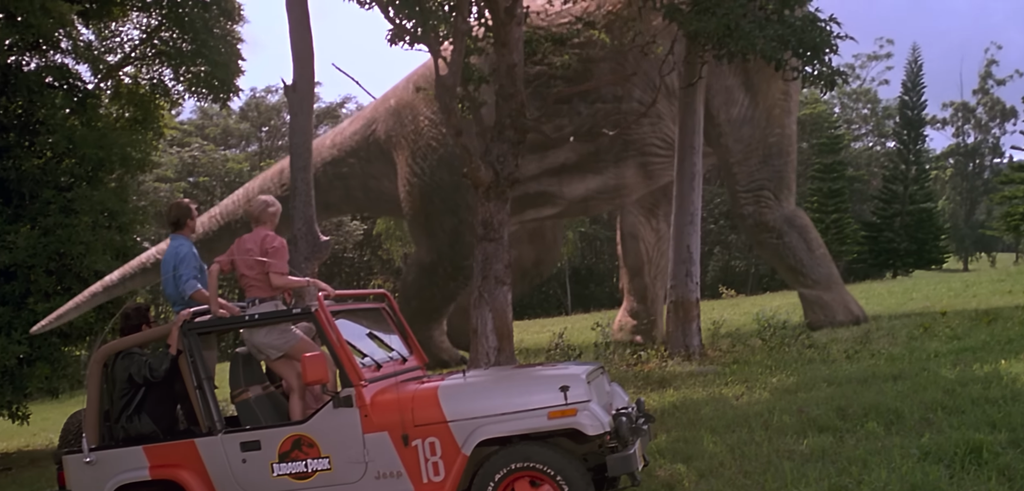
The wide shots of the Brachiosaurus were created digitally by Industrial Light & Magic at a time when convincing computer-generated animals were still largely unexplored territory in feature films. ILM describes Jurassic Park as the first major production to push photorealistic synthetic animals this far into live-action environments, and the peaceful shots of dinosaurs walking through the field and feeding from trees became some of the project’s defining demonstrations of what the new technology could do.
4. The dinosaurs were originally going to be animated another way
The production had initially expected to use traditional stop-motion methods for the full-body dinosaur shots, but ILM’s early digital tests convinced Spielberg that computer animation could produce more natural movement. Phil Tippett’s team did not simply disappear from the process. Their experience with creature animation helped shape the digital performances, and a sensor-equipped dinosaur input device was developed to translate physical animation techniques into computer data.
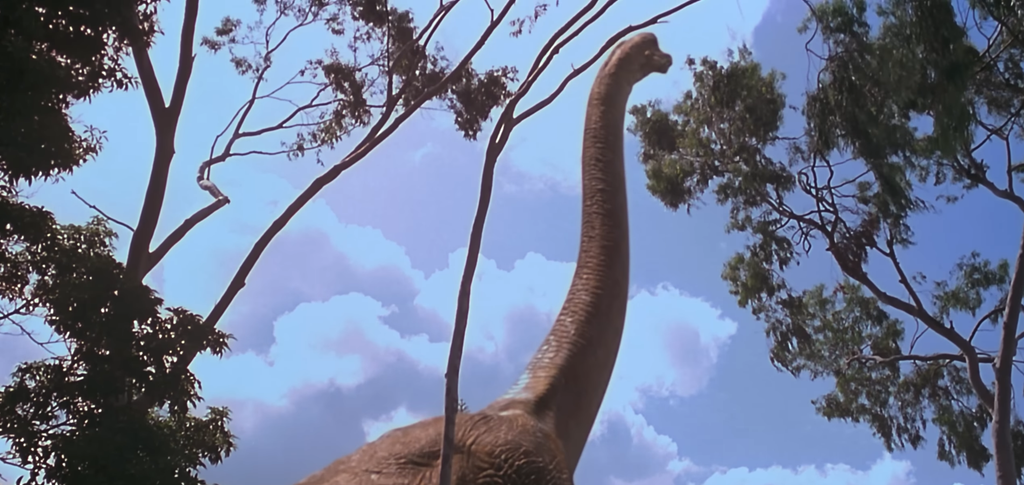
5. The animators wanted its muscles to react to every step
Making the Brachiosaurus move was about more than getting its legs from one position to another. Dinosaur supervisor Phil Tippett recalled that these were among the first scenes the team tackled and that they wanted subtle movement through the animal’s body when its feet hit the ground. That attention to weight helps explain why the creature feels less like a clean digital model floating over the scenery and more like something enormous actually occupying the field.
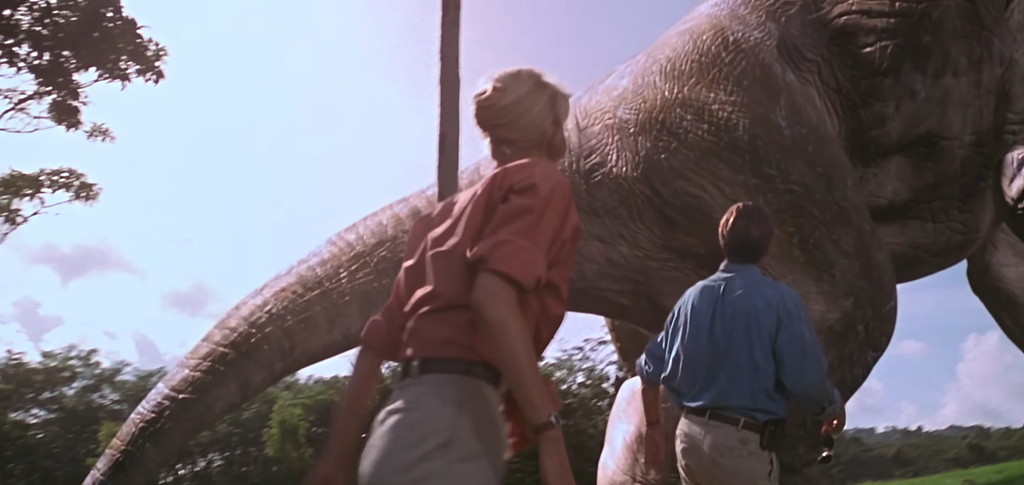
6. The tree really moves when the Brachiosaurus feeds
One of the scene’s most effective interactions with the environment was achieved with an extremely practical solution. Cinematographer Dean Cundey said the crew attached a cable to the top of the real tree and pulled it so the branch would bend and snap at the correct moment. The animators then synchronized the digital Brachiosaurus with that physical movement, allowing the imaginary animal to appear as though it was genuinely affecting something photographed on location.
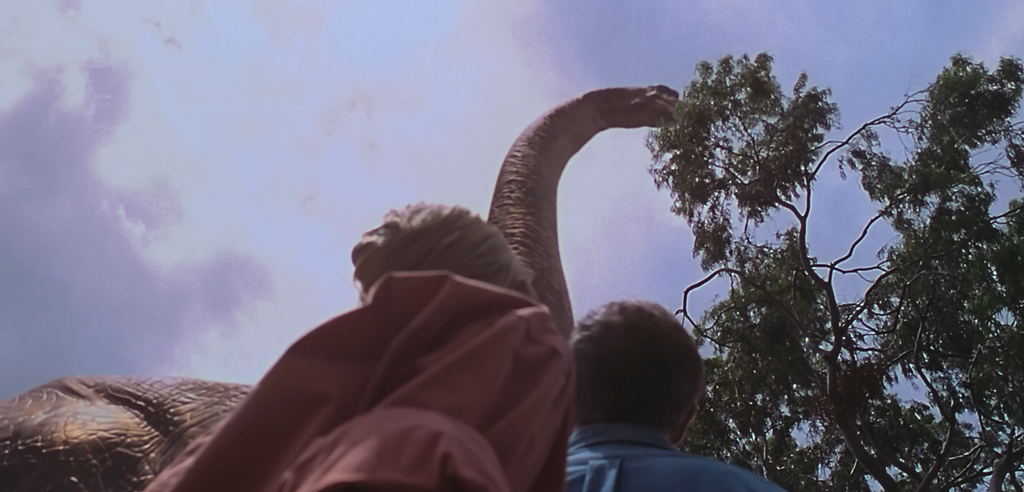
7. A hurricane changed the landscape before the shot was finished
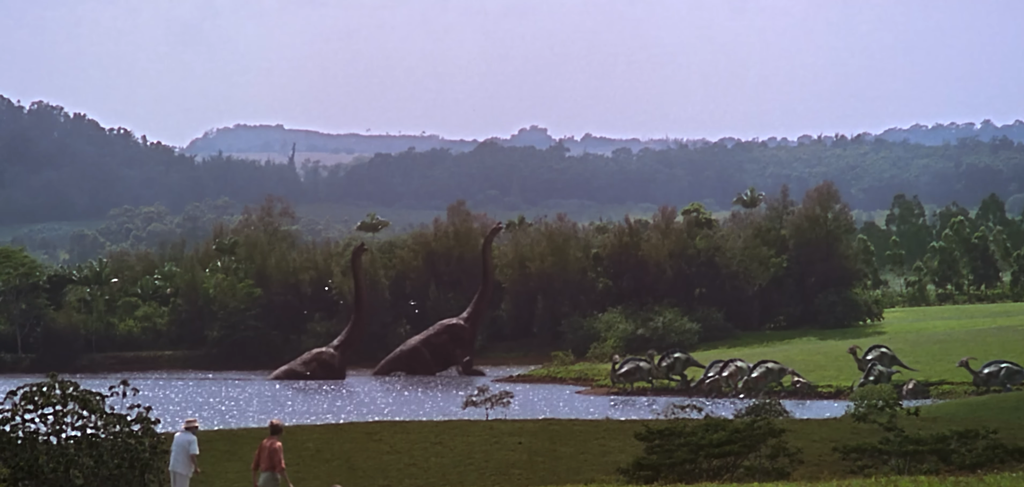
Visual effects supervisor Dennis Muren had photographed a lush ranch during location scouting, but when the filmmakers returned after a hurricane, much of the vegetation was gone. Rather than abandon the original look, Muren used one of his scouting photographs for much of the scenery in the finished Brachiosaurus sequence. Even the water came from somewhere else, with footage photographed at Skywalker Ranch incorporated into the completed environment.
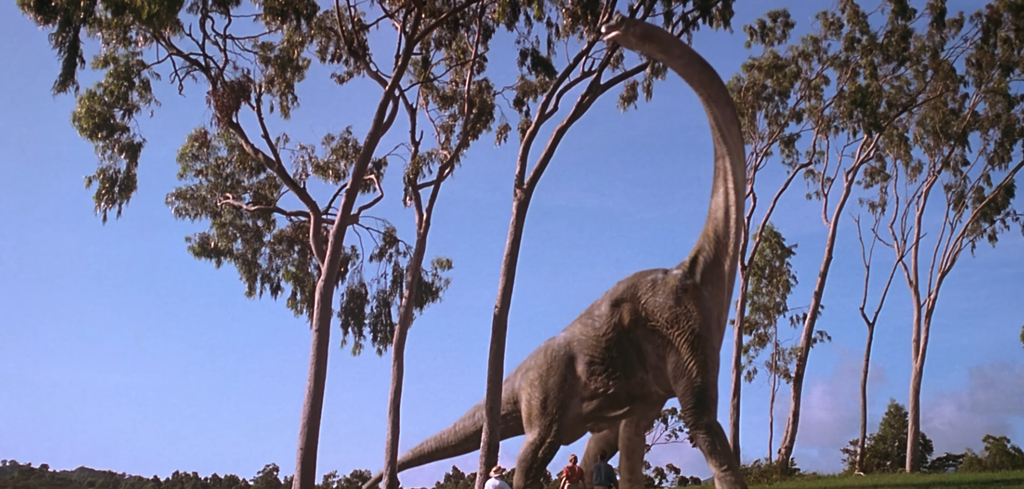
8. Grant losing his legs came from an idea Sam Neill had with Laura Dern
After Hammond casually confirms that the park also has a T. rex, Grant has to sit down as the scale of what he is seeing finally overwhelms him. Neill recalled telling Dern that witnessing living dinosaurs would be so mind-boggling that their characters might practically faint, and he connected that conversation directly to Grant suddenly losing the strength in his legs. It turns what could have been another verbal reaction into one of the scene’s funniest and most believable physical details.
9. The Brachiosaurus’ voice started with real animals
Sound designer Gary Rydstrom built the Brachiosaurus from recordings of animals, including elephants, cows, and donkeys, but its distinctive singing sound had an especially simple source. Rydstrom found that a donkey’s natural, almost yodel-like call became surprisingly musical when slowed down. That softer voice also suited the Brachiosaurus’ role in the scene, introducing the dinosaurs through wonder rather than immediately making them frightening.
10. An early cut used Henry V to help sell the emotion
Before John Williams’ finished music was in place, Spielberg was already testing how the reveal should feel in the editing room. Tippett remembered seeing an early cut in which the St. Crispin’s Day speech from Kenneth Branagh’s Henry V was being used as temporary material and realizing that the scene already worked emotionally. Williams’ finished score gave the sequence the sound audiences now associate with Jurassic Park, but the basic combination of Grant’s reaction, the dinosaur, and Spielberg’s pacing was already doing much of the work.
To Watch or Buy Jurassic Park, click here: https://www.amazon.com/Jurassic-Park-Sam-Neill/dp/B008YI91HS